Two Portraits of a Poet
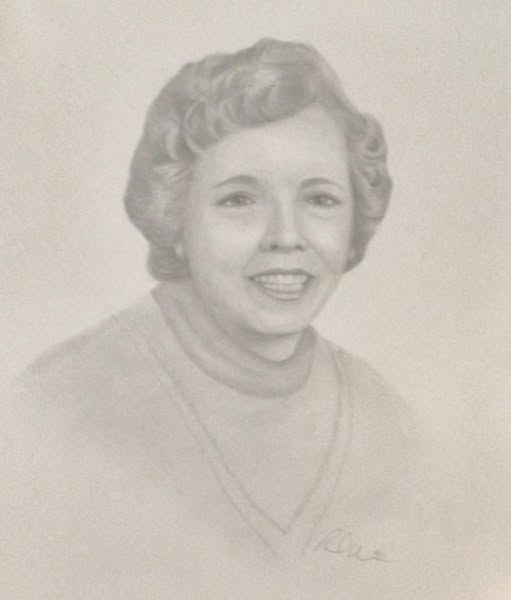
When my brother asked me to write this essay, to accompany a collection of our mother’s poetry, I was mystified and reluctant. She mastered so many things I never will, and he was much more like her, in interests and in temperament. So, it stood to reason his understanding of who she was as a person would be more informed than mine. Since he died before either of us completed our tasks for this joint project, we’ll never know whose instinct about which of us should write this was the correct one.
From the body of a woman so striking she modeled swimsuits and runway fashion in the 1940s and later became a poet so humble about her talent she never sought publication, came a daughter: her only girl child, willful, unfiltered, certain of her own opinions, and forever totally clueless about poetry any deeper in meaning than Burgess’s The Purple Cow. But this isn’t about me. This is about the poet.
I worry that sharing what I know of her may inadvertently make this more about me than it should be. That’s not my intent. But I’m not sure I can avoid it since my view of her as Agnes’s daughter, my father’s wife, our mother, and finally one of my most enduring friends was built through a lens only I had. Knowing just the biographical facts of a person’s life seldom gives any real insight into their personality, or any of the other important characteristics that define who that person is or was.
Much of this will be out of any chronological sequence. At 73, I’m to be forgiven for some of that, but it’s really because when we examine the wholeness of someone’s life, what we see isn’t the linear view of a timeline. It’s a quilt pieced in a pattern discernible only to the maker and, to a lesser degree, the ones it kept warm over the course of a lifetime.
The bridge between my intent and the likely result is well illustrated by the pencil portrait of her leading into this essay. Shortly after Mom died, Dad commissioned a portrait of her and asked the artist to complete the work using our favorite photo of her as a reference. The man did an amazing job from the texture of her hair to the look in her eyes to the woven threads in the sweater she was wearing when that picture was taken. The only feature he didn’t capture correctly was the shape of her teeth, and that small flaw in visual accuracy transformed her likeness into a slightly marred reflection of someone we thought we knew. In this verbal illustration of who she was, I’m certain there are parts of her that I will not correctly capture, and for that I offer apologies to her and to all of you. Like the portrait artist who preceded me, all I can do now is work, to the best of my ability, with the picture in front of me.
She wasn’t perfect – none of us are – although the view from my old eyes sees her as far closer to that ideal than the ever-rolling eyes of my youth saw her. If she suffered from any of the Seven Deadly Sins, it would have been Anger and Pride, and those only occasionally. That internal struggle was most visible during and after infrequent instances of stress-fueled anger interrupting her otherwise good-natured poise. She was a woman of great patience, but she had a Jekyll-and-Hyde tendency to turn irrationally vicious and eviscerate the closest target when her last available nerve snapped.
Those eruptions, when they came, had the force and subtlety of an atom bomb on an anthill, and it took her a while to recover her typical equilibrium. When she did regain her balance, the words “I’m” and “sorry” had either temporarily escaped her vocabulary, or she didn’t know how to combine them into a singular phrase. I don’t want to leave the impression that she lacked remorse or rejected taking any accountability for the way she expressed herself in those moments, but her form of apology – although sincere – wasn’t direct, and it wasn’t verbal. Listing her minor flaws would simply be a petty waste of time.
Because she was a poet, she told my dad, my brother, and the rest of her world what she wanted to say in her poems. In my case, she had long since accepted that as an exercise in futility. She never judged my lack of interest in ferreting the meaning of riddle-laden metaphors from endless lines of words that frequently lacked discernible rhyme or rhythm. She just accepted the limitation and excused it, telling me that in her experience people who were very direct in their communication style often disliked the subtleties of poetry. She built her gift to me using the only other tools she had available, and I’m able to see her and draw her clearly because of the verbal landscape she provided.
Putting aside for a moment the enormity of her gift to me, the bittersweet irony of accepting the tasks left by my brother has been that by finally beginning to understand her poetry, I’ve come to understand myself. Where the outward appearance of my personality has always mirrored the boisterous assertiveness of my father, the inner core that drives me is far more rooted in my mother’s unyielding view of the line between right and wrong and her unflinching understanding of the times she crossed that line. Through this project, I see more clearly than ever before that I’m her daughter too.
When we knew the end was coming, and we knew we couldn’t stop it, I spent as much time with her as I could. She used that time with me to let go of subtlety and hint in favor of direct communication. Her gift to me wasn’t delivered as themed verse, and I didn’t understand what she was doing at the time. In fact, I viewed it as peculiar and there were days when it made me distinctly uncomfortable. It took years for me to recognize what she did during those private afternoon gab sessions, time-boxed by the hours when it was my turn to sit with her. She sometimes came perilously close to oversharing. To her credit, she never really crossed the line of propriety, but she did often skirt the boundaries, and she was relentless in her need to share the fabric of her life with me.
She needed me to see her as a whole person and to have a glimpse of the world through her eyes. She needed me to understand that as much as my brother and I enriched her life (her words, not mine), she was a person of faith, depth, interests, and experiences that had nothing to do with us and that it was the sum of all those parts that made her whole. She needed me to know that the concentric circles that rippled outward from her life encompassed but were not limited to her career as wife and mother.
She never saw herself as a feminist, but before she left me, she wanted to know that I would try to live my life on my terms, balancing my interests and wishes against my husband’s, and not cave to the societal pressures of her generation; pressures that demanded service to self be totally subservient to service for husband and family. If she ever thought I had any real aptitude for that, our conversations might have been quite different. During those final months, she continued to drive that message home, along with a road map on how to get there. She did that without expressing rancor or resentment for any of the people that had passed through or stayed to populate her life, however poorly some had treated her.
There were times during the hours spent with her when I was angry with her, because I knew she had quit trying to stay. But more often, I was angry for her and with those that had contributed to the disappointments and struggles of her life. Heading that list was my father. To steal Alice Roosevelt’s reflections on life with her father, “My father was the bride at every wedding and the corpse at every funeral.”
Dad would have been comfortable in the halls and parlors of Stepford, Connecticut. I’m certain he loved my mother, but I doubt that he ever saw Mom’s love for him as the gift it was. Instead, he saw it as a positive reflection of what a great guy he must be. I can name several people, including his parents, who lacked warmth or fondness for him. But I don’t know of anyone who didn’t like her instantly, apart from his mother and those whose opinions she had the ability to influence.
The source of the conflict between my mother and her mother-in-law was, of course, my father. Starting somewhere in Dad’s early childhood and lasting until their last breath, my paternal grandparents did not like him, and his mother seldom made any effort to hide that from him or anyone else. The damage done to my dad by parental rejection doesn’t require a PhD in Human Psychology to grasp, but he’s not the subject at hand here, and he will get his turn later, with a more balanced view. For my mother’s story, even as part of a long list of reasons he may have been the way he was, it doesn’t fully excuse him. Mom, however, was his stalwart defender, and that alone was enough to earn his mother’s hidden animosities. I’m bringing his human failings into a portrait of my mother because you need a clear picture of him to fully appreciate the depth and generosity of my mother’s character. That she loved him as she did, almost defies human understanding.
If she ever lamented her loss of self or the personal opportunities she gave up in pursuit of helping him achieve his professional and personal potential, it was only within her own private thoughts and she never, even once, gave any direct voice to the sacrifice. The closest she ever came, to the best of my knowledge, was in her incessant urging that I not lose myself.
The single leisure-time pursuit that she and Dad equally enjoyed was hosting parties. Whether it was Saturday night bridge parties with a few friends, day-long open-house events, election night bashes, or group celebrations for those who had been promoted, there was always a party at some stage of planning. It was a crucial skill for the wife of a career Air Force Officer, where advancement in rank was as much based on the perception of character, viewed through the lens of family life, as it was on technical skills and leadership ability.
For my father, the view through the picture window into our lives was always about him; always a reflection of his character, his prowess in attracting a mate worthy of sharing his life, and his skill as a parent. If any friend or acquaintance remarked on my mother’s grace and beauty or how well my brother and I conducted ourselves in public, he polished those compliments until they were so bright and shiny, he could see only his reflection.
Whatever the cause, the most consistent behavior in my dad’s life was that he would not participate in what he could not control. In 1968 he resigned from the Air Force, the moment he had 20 years in service, and about two months after he was, for the first time, denied a promotion. For the next 17 years he struggled with a series of personal failures that were primarily the fault of his inability to acknowledge his own flaws and shortcomings. When any plan falls short of its goal, there’s always value in honestly assessing who we are, acknowledging our mistakes, and giving thought to how we could have contributed to a better outcome. He was incapable of implementing that strategy.
That flaw stands in stark contrast to my mother’s self-aware and self-reflective nature. She had a highly developed sense of right and wrong, devoid of the conscience-dodging conveniences of situational ethics. In one of the places where she was a digit in the census roll of a small town, she went to work as an administrative assistant for a ranking member of the town’s elite, a man who happened to hold a local government position. She hadn’t worked there long when she uncovered significant financial malfeasance and, given the scope of the misdeed and those it was hurting, she would not stay silent. The fallout from that is captured in her poem, The Verstag Review, which in the words of my brother is “difficult to unpack”. In it she describes with sharp wit, and sharper words, her fall from grace, in the view of the village residents she had considered friends, and the consequences she paid. It exemplifies the belief that no good deed goes unpunished, but she does not spare herself in it either. She gives voice to her realization that if she had handled it better there might have been a different outcome.
Because Dad lacked any ability to make course corrections based on self-reflection, his life and hers with it unraveled fast. Within three years of retiring he lost the business he started after his separation from service, lost to foreclosure the property he and my mother bought when he retired, had their car repossessed, filed bankruptcy, and narrowly avoided going to prison for shenanigans with corporate payroll taxes. That generated a relocation to Los Angeles, where they spent the next four years regaining lost ground while my mother worked, and he spent much of his time chasing new dreams.
The next move required trekking halfway across the country to a small town in Minnesota. It was the first solo move since the earliest days of their marriage since they were, by then, empty nesters, at least temporarily. Dad wanted to try his hand at teaching eighth graders in a parochial school where the principal was a priest and a longtime family friend also retired from the Air Force. They arrived sometime in January and Dad’s brief career as a teacher was over before the ice melted from the tundra although, since Mom loved that town, they stayed for another three years.
During that time, I rejoined them, alone and pregnant with my oldest child. Three months after my re-entry into their daily lives my brother’s first marriage irrevocably collapsed. Within days of the final point of failure, he arrived and moved in with his twin toddler daughters. A few days later I gave birth with my mom beside me in the delivery room. My brother and I leaned heavily on them while we put our respective lives back together and then we scattered again, this time at a distance that could be covered within two hours rather than taking three days. In the spring of 1979, my mother agreed to move again so that Dad could return to work as a systems analyst.
The cost to Mom was enormous. Within two months of that move, she suffered a major mental breakdown; one that included a months-long stay in the locked unit of a psychiatric ward aligned with the Mayo Clinic in Rochester, Minnesota. The pressures from Dad, my brother, and me may have been contributing factors, but there were also physiological causes triggered by the drugs she was given when she was hospitalized for a life-threatening strep infection, several weeks before the breakdown. Massive doses of steroids can be nasty business, especially for someone already dodging landmines on the path marking the boundaries of their own mental stability.
Predictably, Dad made much of that experience about him too. The time my brother and I should have been able to spend supporting her, while still parenting our own kids, had to be carved into another piece to manage our father’s insecurities. He was concerned with how her illness might affect him, and preoccupied – seeking absolution more than offering penance – about what he might have done that would cause her to run screaming into the street wearing her robe and slippers. When she got there, she flagged down the first hapless motorist that would take her away from whatever danger she imagined. She eventually recovered, but it was a years-long process and her resulting temporary inability to continue her role as his emotional support person resulted in a brief threat to both her recovery and their marriage.
About a year and a half into her recovery, part of which encompassed her recognition that she was also entitled to voice to opinions that should have some weight in decisions made about their joint ventures, he decided that they should part company. He was going to be out of town the weekend following this decision and I made the trip from Minneapolis to Rochester to spend it with my mother. She was perilously close to another retreat from reality. Then she rallied and seemed more stable and ready to deal with the decisions she needed to make so I left, at her insistence, shortly before he was due to return. By the next weekend, the situation had corrected itself. In retrospect, and because of what followed, I strongly suspect that she caved to his plans to save both her marriage and her sanity for the time she still needed to recover.
From the outside, looking in, it appeared that his remedy for all that had happened was another fresh start and another move, in pursuit of joining a community of people with whom he shared some interesting views about religion, politics, and the government. As it turned out, he didn’t get along with them either after they wised up to his capacity for BS and his insatiable need for recognition. While he seldom stayed for long, he had an uncanny ability to find other groups of like-minded people. It was these interchangeable groups of non-conformists that claimed the lion’s share of his attention while Mom battled the cancer she found and then kept to herself until the move was completed, so it wouldn’t interrupt his plans.
I never hear the phrase “trophy wife” that I don’t immediately visualize my mother. One of my favorite photos of them as a couple is a stunning picture of her in an exquisite gold-threaded black gown, on my father’s arm, as they entered a formal NATO Alliance military banquet, during his assignment in Paris. It’s a photograph that is traditionally worthy of a Trophy Wife title, but the phrase remains shallow until that image of her is contrasted with one diagonally adjacent to it in a framed collage. The second picture was taken 18 years later, about 26 months after her mastectomy. In that snapshot, dressed in plaid double-knit slacks and a dirty T-shirt, she toiled with a spade, in 80% humidity on a 90-degree August afternoon, helping Dad free a tractor-driven auger from the tree roots it had tangled with in deep mud. Ever true to himself, my father asked me why I had included that picture with the ones that really highlighted her beauty.
I spent all the years between my dad’s retirement from the Air Force and the day that picture was taken, plus another decade, wondering why Mom was so gracefully acquiescent to the needs and impositions demanded by my father. I didn’t know if I’d ever understand all of it, but I did know that my maternal grandmother was a big piece of the puzzle. Although she is also not the subject at hand, I want to briefly pause here and clarify the use of the phrase “maternal grandmother”. Its only use here is to describe lineage, without regard to any missing natural instinct.
In the vernacular of today’s pop-culture, Agnes was what we would call “a piece of work”. She was a frequent fixture in our household as my brother and I grew up, moving from Air Force base to Air Force base because, I think, Mom was still desperately trying to get her attention. She lived with us more often than she didn’t and in my early childhood I adored her. She was fun and she was not reluctant to try to undermine my parents’ efforts to discipline their children. When that failed, as it usually did, she would simply give us what we wanted once they were out of sight. What five-year-old wouldn’t think that was a caped hero? By the time I was 12, I could see fostering that tug-of-war was not in my long-term best interest, and I began to distance myself from her. By the time I was 14 I couldn’t stand her, and that lasted for at least a decade.
The year I was 21 my mother and I had a lengthy discussion one night about her family history; one that began to illuminate her relationship with her mother and her relationship with Dad. I never met my maternal grandfather. He died from Hodgkin’s Disease in mid-May of 1952, before I was born in late June. He was a warm and loving man, as well thought of by those outside the family as he was within the family. The only thing he lacked in character was the backbone and strength needed to be married to a woman like my grandmother. He tried multiple times. At the time of his death, he was working on his third marriage to her.
I’m not sure what the chronology of those marriages was; how long each one of them lasted, or what the time gaps were between them. I know that they started before the Great Depression, since my mother was the second of their two children, and she was born in 1927. And I know when and how their story ended. I know that he was a pipe fitter, and like most sole providers who wanted to stay employed during the Great Depression, he had to go where the work was; and it was never local. My grandmother and their children remained in south Texas, either because it was more economically sound for them to do so during those years or, more likely, because my grandmother did what my grandmother wanted, when she wanted. Unfortunately, that usually didn’t include keeping herself tied to a man who was seldom home and could not keep her stylishly comfortable.
When my grandfather was away, she had little trouble keeping herself amused with the company of other men. I don’t remember a time when I didn’t know my grandmother “worked in the shipyards” during the war, but the more Mom talked that night, the more I wondered exactly what the nature of that “work” might have been. One of her suitors, a man my mother called Daddy Bob, married my grandmother twice, once during each of the two divorces she handed my grandfather.
A large part of my mother’s depression era childhood was a pendulum, always in motion, swinging from an environment where her parents could barely put food on the table to an environment where the living was as lavish as you would expect from a Panhandle wildcatter during the early days of the oil boom. Those swings in fortune were accompanied by spans of time when she was all but orphaned. Agnes routinely abandoned her children to any members of a large extended family willing to take them, while she took off with whatever man had her attention at that time. Mom’s aunts and uncles, from both sides of the family, became her acting parents and her cousins became her siblings. And then she would be torn from them when it suited my grandmother to step back into her assigned role. And through most of it, all my mother really wanted was for her mother to want to be with her.
By her own words during that conversation, Mom grew up wondering what she lacked that made her mother find her presence so intolerable. Somewhere in those years of emotional starvation, it’s clear she made herself a promise: when her turn came, her children would never feel that longing for maternal love or doubt its presence, even for a moment. And somewhere on that map of all the places she was dumped, and all the people that populated those places, somebody betrayed her trust and abused her in ways her generation spoke about only in hushed whispers, if they spoke about it at all. Nobody but my mother will ever know who it was or what really happened. She only spoke of it once, briefly and without detail, on the day she temporarily lost touch with most of reality.
I know that both people anchoring her formative relationships also had their positive attributes. I know enough about their early life histories to partly understand why they were the people they were. They weren’t monsters. But as adults, they both lacked the ability to place the needs of others ahead of their own wants, and neither could express the kind of empathy necessary to validate the worth of those they loved. I read someplace that the fusion of internal insecurities and external relationships forge who we become in the world. I think that’s partly true, but my mother, in her quiet way, refused to be placed on a back burner as a passive partner in those relationships. She fought her way out of that corner, to who she was in the world, through the self-identified goals and values she built in the absence of their support. And then she found the way to express who she was, and how she fit into the world, through her poetry.
During the last month of her life, we continued our conversations about my father, her mother, my new husband, and the paths of our lives; where hers had led and where mine might take me. After decades of wondering silently, I took the opportunities offered to finally ask her “Why?” and “How?”. In separate references to both Dad and Agnes, she noted that they could both be quite charming – when it suited their needs. I told her that might explain why she married Dad, but offered no insight into how she managed to stay married to him. Then I voiced a similar disconnect about my grandmother.
Her explanation wasn’t delivered in a single short paragraph. But stitched together, over the course of at least three or four conversations, she gave me the road map she’d used. She told me that there comes a time in the life of most people, long after we’ve joined the ranks of adulthood, when we remove the goggles of childhood and finally see our parents as people. She told me that infatuation helps hide someone’s flaws and shortcomings. That concealment is necessary until time and the petty grievances of daily life chip away the veneer. By then, for the lucky and the wise, the joys doubled, and sorrows halved by the union have built layers of love in the ashes of infatuation. She told me that forgiveness is the only door that lets us navigate around obstacles born of failures outside our control, and because she had loved them both, as well as she was able, she’d always been able to find the door she needed to find.
When her cancer returned after a four-year remission, following the initial surgery and treatment, her doctor told her the metastases that had occurred made it inoperable and probably incurable. She never flinched. She calmly asked for the doctor’s opinion about time remaining and the doctor’s exact words, delivered as kindly as possible, were “Mittie, anything over six months is a gift.” That gift lasted a full three years, with much of that time spent when it would have been so much easier for her to pre-pay the debt. And she wasted not a day of it on feeling sorry for herself or lying to herself or others about what the outcome would be. She simply carried on with her life and lived around the “inconveniences of her condition.” She lost and buried her mother during that time but gained a son-in-law and she also welcomed two additional grandchildren to the family. Like her father before her, she missed being able to say hello to her youngest grandchild by only a few weeks.
It’s still hard to talk about her death. It was slow and increasingly painful, and she bore it all in a way that gives meaning beyond the shallow platitudes of the phrase “death with dignity”. Through all of it, from the moment she discovered the first lump to the day the fight ended, she never said “why me”, and she never said, “I can’t do this”. She simply prayed for the strength to accept whatever she needed to endure. That list included reactions to chemo that required multiple, lengthy hospitalizations, pulmonary invasion that almost took her from us 19 months before she finally died, and then a final metastasis into a skeleton already ravaged by the effects of chemo. When she quit chemo and started radiation, in those final months, it was only for palliative care with no hope of cure. Her response to hearing that radiation had been added to her list of treatments was to ask her doctor if she would be glowing at her own funeral.
As the end got closer, her hospitalizations were increasingly more frequent, more intense, and less certain she would exit still breathing. About three weeks before she died, at home, on an otherwise perfect and sunny October day, she was in the hospital recovering from a surgery where they had removed a softball-size tumor from her right hip, discovered after she broke it just by pivoting onto the chair by her bed. A long-time family friend, who had on at least one occasion become intimately familiar with the full force of her temper and loved her anyway, came to see my mother in the hospital. He was on his way to somewhere in Alabama to retrieve a priest she particularly wanted to administer her Last Rites, and he was afraid he might not get another chance to say goodbye. As he was leaving, he leaned over to kiss her on the brow and told her he wished she didn’t have to suffer so much. Her response was to thank him for his thoughts and to ask him for his prayers to help her endure the suffering rather than diminish it because she believed how we carry the burdens of pain, both physical pain and the emotional pain of righteous betrayals and disappointments, will serve to shorten our time in Purgatory. Her time must have been short, indeed.
Her view of the debt we all owe our Creator, the certainty of His recall of our souls and the atonement required for the remission of our sins, is evident in both The Coping Stones and in The Rhythm of the Danse. (She would be pleased to know I did understand at least that much). And what I learned from her poetry, as I followed the path to finish this project, finally offers the clearest explanation for her mostly willing and graceful acceptance of the crosses she carried.
“The Cross is the way to Paradise, but only when it is borne willingly.”
–St. Paul of the Cross
 The Coping Stones