“Remember to keep holy the Sabbath day.  Six days you may labor and
 do all of your work, but the seventh day is the Sabbath of the Lord,
your God.  No work may be done by you, or your son, or your daughter,
or your male or female slave, or your beast, or by the alien who lives
with you.  In six days the LORD made the heavens and the earth, the
sea and all that is in them; but on the seventh day he rested.  That is
why the LORD has blessed the Sabbath day and made it holy.”
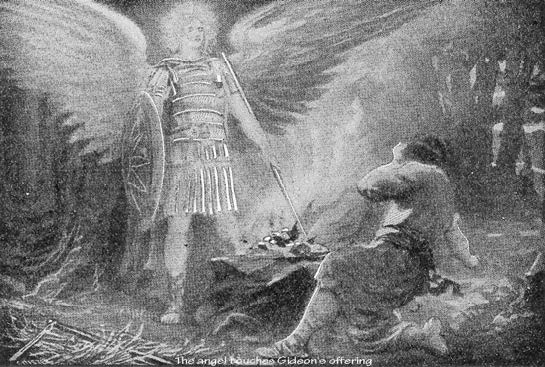
Judges 7
7    "And the Lord said to Gedeon: By the three hundred men, that lapped water, I will save you, and deliver Madian into thy hand: but let all the rest of the people return to their place."
20  "And when they sounded their trumpets in three places round about the camp, and had broken their pitchers, they held their lamps in their left hands, and with their right hands the trumpets which they blew, and they cried out: The sword of the Lord and of Gideon!"
21  " Standing every man in his place round about the enemies' camp. So all the camp was troubled, and crying out and howling, they fled away."


O Lord,

From Ahimsa of Jain to Buddhist Zen
seraphic golden flowers cultivate
Gautama’s secret doctrine taught to men;
that petals, viewed aloft, illuminate
perceptions only when I contemplate
upon the mystic qualities therein
for wordless answers to my temporal state.

I am of late a stranger to the need
to congregate enmasse each Sabbath day;
and more inclined to silently recede
into an introspective hideaway
that I might one-to-ONE communicate.

Mute pleas form as I kneel low to Thy will
at unpretentious alters of my choice.
Then three comes slowly stealing forth until
a cloudy sea of doubt obscures Thy voice;
and two-in-ONE, like mist, evaporate.

This day John’s Sabbath dawned to toll Thy bell
Beaconing Legionnaires to Tennessee –
while Peter’s heir commissions souls to dwell
in Thy embrace throughout eternity –
so doubt may see why cloisters congregate.
| The Curator’s Notes: This poem wrestles with the Third Commandment’s requirement to “keep holy the Sabbath day” through corporate worship, while the poet feels drawn to solitary contemplation. The inclusion of Gideon’s story adds a crucial layer: God often works through small, faithful remnants rather than large assemblies—but even Gideon needed his 300 to act together. The wasn’t struggling with preference for private prayer over communal worship. She was geographically and liturgically exiled from the Traditional Latin Mass she considered valid. Living between Chattanooga and Knoxville with only irregular “pop-up” TLM availability (often requiring travel to Atlanta), she faced an impossible choice: attend the Novus Ordo Mass locally (which she found irreverent and possibly invalid) or maintain fidelity to traditional liturgy through private devotion when no valid Mass was accessible. This wasn’t rooted in laziness or personal preference. It was an exile. The poem explores whether private prayer can substitute for the Mass when corporate worship of the right kind is unavailable. |
 The Coping Stones